
George Rodrigue
Louisiana Artist
New Iberia, LA
From the George Rodrigue Life & Legacy Foundation:
A traiteur is a Cajun folk doctor with a special, inherited gift for healing one ailment. In George’s painting, Doc Moses heals earaches. He pours a ring of salt around the patient and touches his ears. Amazingly, only the healer must believe. The patient’s skepticism does not affect the cure.
George also knew of a woman in New Iberia famous for treating warts. She concentrated on one wart a day and could even work over the telephone if you described to her the exact location of the growth. However, the power did not work across water, and so if you lived on the other side of the Bayou Teche, you had to cross the bridge (or take a pirogue) to the opposite bank to make your call.
George’s cousin Catherine tried healing sprains after finding Tant Git’s prayer book, which doubled as her healer’s manual. Magitte, George’s mother’s oldest sister, was born in 1880 and inherited the book from her father. But somehow the power never passed to Catherine. Ironically, she became a nurse, healing in more conventional ways, a practice she gave up because her kind heart cannot bear to see suffering.
Today Catherine and her husband Victor own Victor’s Cafeteria in downtown New Iberia, and the idea that she’s a ‘healer’ is long gone (although no doubt her delicious crawfish pies and pralines have cured a few ailments). She and her sisters Susan and Cheryl, along with their brother John Edward are the closest thing George has to siblings (for more on this, see the blogs How Baby George Became an Artist and Tombs in the Life and Art of George Rodrigue).
And indeed George does complain about Catherine as though she is his sister, most notably regarding the sign at Victor’s Cafeteria that says “Detective Robicheaux eats here,” based on author James Lee Burke’s famous character. George of course thinks the sign should tout a different local celebrity!
I’ve never met a traiteur nor witnessed a healing. George saw it many times. His Tant Git, to heal a sprain, licked her thumb and traced three small crosses with it on the injury while whispering secret words from her prayer book.
One day John Edward, Catherine’s older brother, asked Tant Git about the process and how she heals. At ten years old, he was convinced that he should be the next family traiteur. (light as a feather…)
She agreed to share her secret, as long as he promised to tell no one. Meanwhile, John Edward had a secret of his own: he planned on a healing demonstration at school for show-n-tell. Magitte showed him the ritual and said the secret words out loud. John Edward, not speaking French, didn’t realize that Tant Git fooled him, as he repeated to his class three times in French: ‘dog poo, pig poo’….. But his teacher, who understood French, was horrified!
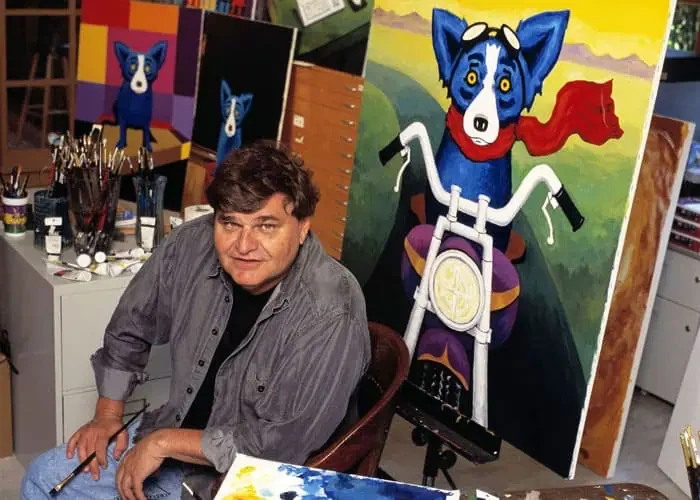
George has painted several traiteurs over the years. If you follow this blog, you might remember Evergreen Lake as a Native American model for the healer from the story Rosalea Murphy, the Pink Adobe, and Paintings of Evergreen Lake. He hasn’t addressed the subject on canvas in quite sometime, but he’s been known to entertain at dinner parties, particularly over injuries, with three little crosses and the magic words…
Caca Chien, Caca Cochon, Caca Chien, Caca Cochon, Caca Chien, Caca Cochon….
Sounds like voodoo to me-
Wendy
Between the lush environment and Murrell’s attentive feeding, Murrell cultivated a massive population of migratory as well as resident birds. If a human visitor was fortunate enough to go on a bird walk with Murrell, they experienced an intimate glimpse into nature. “People loved to go on bird walks with him, because he was just so calm and casual, you know, but just knew everything, and where to see all the nests, and he fed billions of birds,” Anne explained, noting that Murrell not only filled bird feeders, but regularly scattered corn by the lakes. “I’ve been down there when he would have two hundred Canadian geese come in to spend the night. And then they’d all go off to wherever they lived, but they would always come to his lake to spend the night.”
To the people who knew him, he is remembered fondly as an “old-school gentleman,” humble, polite, generous, and kind. While he curated his own bird sanctuary at home, during the course of his life he also found joy in traveling to locales like Spain, Africa, South and Central America, as well as elsewhere within the United States on birding trips with colleagues who shared his passion.
Murrell’s deep love of nature and gentleness toward animals goes back to his childhood. While he was born into a family of hunters, he was more influenced by his grandmother, a horticulturist who operated a plant nursery during the Depression; and his mother, who was an artist and fashion illustrator. “They were surrounding him with fine art and wonderful books and paintings and everything, and so he was a little different from the hunters,” Anne said. “He just had such an appreciation for everything in nature.”
And yes, she means everything: when Murrell was a child, he had a pet buzzard who would follow him out to catch the school bus every morning. When he was in his eighties, Murrell built buzzard nesting boxes for them to roost. “So, nothing escaped his attention. The only thing he didn’t like was cats,” Anne recalled with a chuckle. “He didn’t like cats around his house, because they would kill the birds.”
While Audubon, as prolific as he was––and as profoundly as Murrell respected him––had an assistant paint his backgrounds, Murrell always painted every detail himself. “Every plant and every habitat and every feather, it was all just perfect. You know, and he really spent a lot of time studying and walking in the woods, and was just was so knowledgeable about everything in the natural world,” Anne said. “He loved everything about it.”
This profound love of nature has culminated in Murrell bequeathing his estate—the bird-dotted 350-acre property, and the two-story log house filled with art old and new by himself and other artists—to the National Audubon Society, with the intent that it will someday become a museum and birding study center for migratory and resident birds.