Charles Sprague Pearce
American, 1851-1914
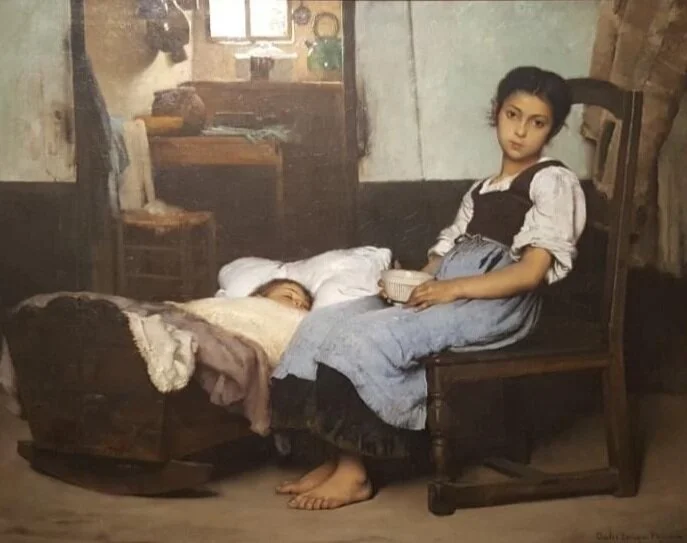
Charles Sprague Pearce’s Little Mother is a favorite among museum visitors. It is steeped in open-ended narrative, allowing for multiple interpretations. The cropped interior scene creates an immediacy that draws in viewers. The girl’s direct, imploring gaze seems to beckon. Originally titled Baby and Sister, the painting might depict a young girl who is helping her mother by minding her younger sibling. Her relaxed, seated position may be one of repose, as she pauses to rest from her duties.
Her position could also convey exhaustion, and the cropped view could communicate feelings of entrapment. This analysis emerges if we consider the high death rates among women during and after childbirth throughout the nineteenth century. In this interpretation we see a motherless girl who, at a young age, had to assume the responsibilities of a mother. Although she looks like a child, her role is quite different. The only visual escape from her maternal duties is to the kitchen, where more work awaits. The white bedding and illuminated cradle emphasize the sleeping infant’s innocence. They stand in sharp contrast to the older sister’s hands and feet, which are dirtied by work.
One of the original titles of this painting was Repose, and it was exhibited in Munich, Germany in 1883. Pearce drew a picture of the painting for an article in The Art Amateur magazine in 1883. The caption read Bebe et sur Soir - Souvenir du Mide—translation: Baby and Sister - Memory of Midi.
Born in Boston, Massachusetts to a wealthy, cultured and artistic family, Pearce went to Paris in 1873, where he studied art under Leon Bonnat. He remained in France, married a French woman and maintained his studio in Auvers-sur-Oise until his death in 1914.